 bruce lawson
@brucel that sounds like a good balance between informing the user and visual noise — should also help discourage the use of query string parameters in permalink design too, hopefully.
Thoughts about #microformats whilst reading Lakoff’s Women, Fire and Dangerous Things — mf vocabularies e.g. h-card, h-entry, h-event are basic-level categories, the level at which:
- it is easiest for humans to learn and reason about,
- we have the shortest, most common names for them,
- defined by how we interact with them
E.g. h-entry ≈ “post”
- short name
- extremely common on the web
- well-defined interaction patterns e.g. writing, posting, replying, reading, browsing through a feed, searching for/within, liking, reposting, quoting etc.
Rather than RDF or schema.org which seek to create pure, objectivist, hierarchies of categories — our brains simply don’t work like that.
Apparently we, as an industry, are over the whole ninja/rockstar thing and have moved onto “mountaineer” weworkremotely.com/jobs/472
“Why yes, my company are interested in hiring PHP-based sailors and javascript treeclimbers. Bring your ropes to the interview, you’re going to need them.”
At any given time my web archive HTTPS to HTTP domain ratio is almost exactly 1:10. Right now it’s at 410 HTTP domains and 41 HTTPS domains. Note that this is just the count of the domains I link to (and which link to me), unweighted by the number of actual physical links.
papaparse.com is a fantastic jQuery plugin for reading CSV files in #js — perfect for tiny feedback loop live previews of file uploads
Renaming “Chrome” to “That browser with Flash”
The medium with which you choose to express a message shapes that message — be careful it doesn’t contradict it.
Case in point: A Rational Web Platform (via @brucel)
- hosted on google silo
- long complex ugly URL
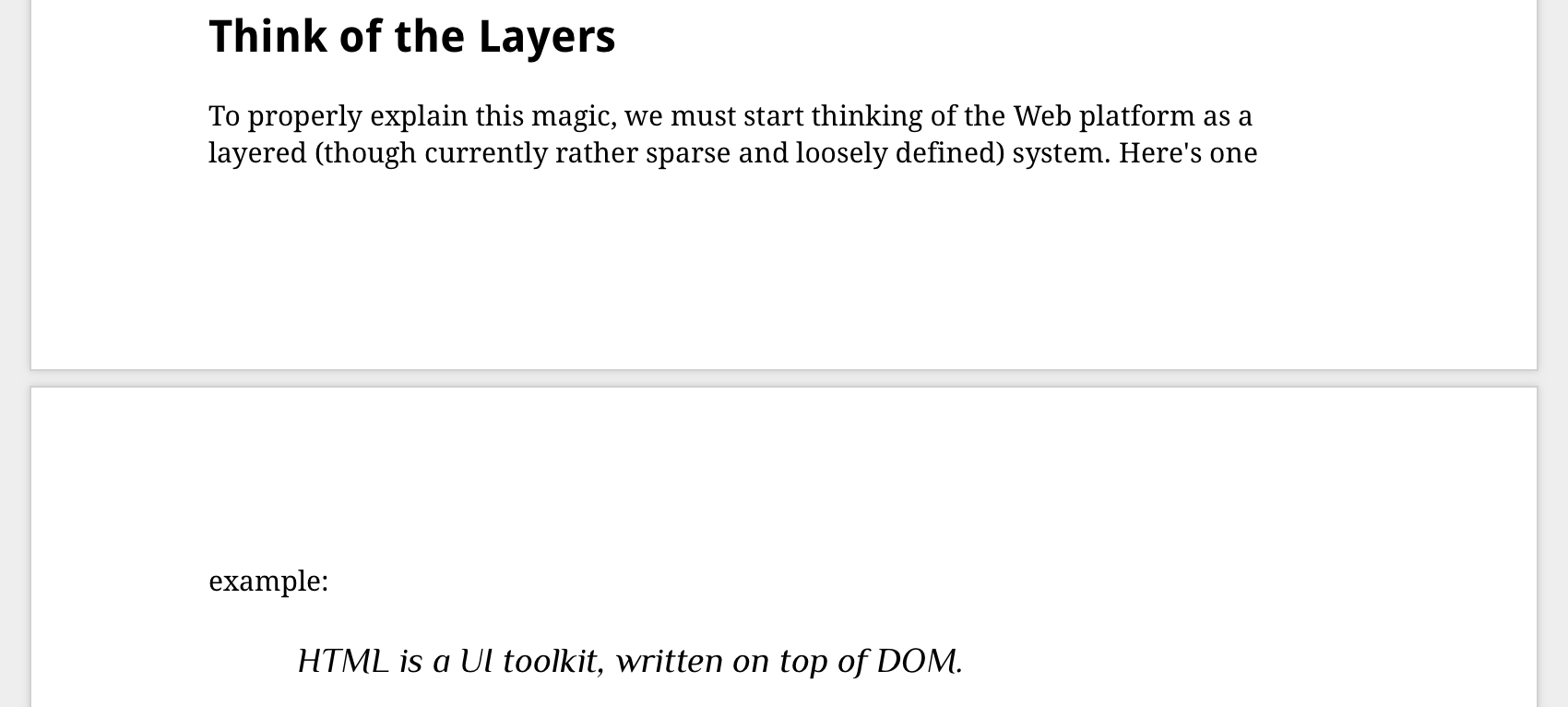
- presentation tied to paged dead-tree media with ugly results:
- no author URL, just corporate silo email, and email != web
- javascript required
- no microformats2 or even semantic HTML
articlemarkup — even js-generated markup is predictably disgusting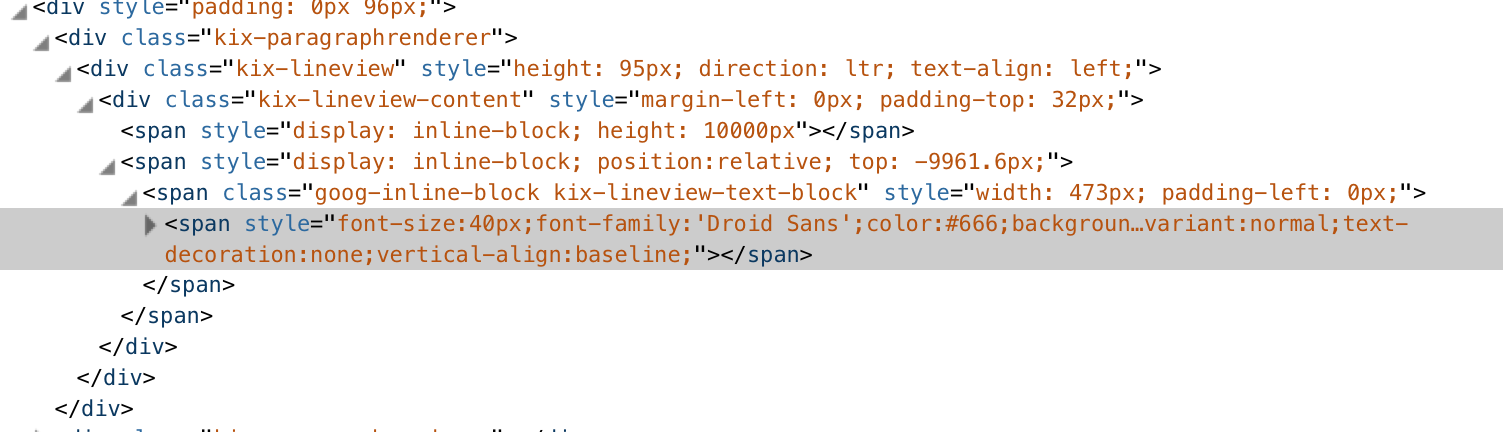
- Redirecting to different (non-canonical? difficult to tell due to ugliness) URL due to large amounts of traffic, likely indicative of infrastructural problems or incorrect medium
- Broken on mobile devices:
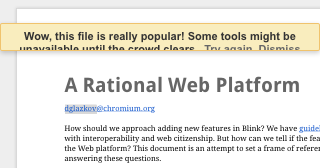
Everything about this is anti-web, practically screaming “ignore me”.
Improvements:
- Host on personal site or project commons with CC license
- Short, consistent, readable URI
- Static semantic HTML with microformats2 h-entry for easy citations, archival and replying, no JS required — this would also solve infrastructural problems as HTML is pretty easy to serve and much faster than JS-rendered DOM-heavy
“documents”applications - Author attributed by name+personal (non-silo) URL, with profile photo/logo for quick human association
My apologies to the @mozilla staff manning the FF Nightly bug reports today, for the stream of gradually less coherent “FF crashes when I drag leafletjs.com maps around whilst making HTTP requests” reports.
Received some spam telling me my website needs a responsive layout. I wonder if @beep gets these emails.
Unsure whether you’re using the <article> element correctly? Wonder no longer, there is a tool to help you out: waterpigs.co.uk/services/test-article #html #web #dev
DuckDuckGo’s r.duckduckgo.com redirects are intermittently giving Connection Reset errors — just one of the reasons why it’s better that they don’t exist. Let each link link to the thing it says it links to.
This evening: documented Yahoo! Pipes UI in case of sudden shutdown, built first mockup of web dataflow UI using jsplumbtoolkit.com — really excellent library, exactly the right balance between functionality and framework. It gives you a lot but doesn’t dictate how to use it.
Another thing I love about the web: users have the power to take control of their UIs and improve their own experiences.
Aside: DRM for HTML would prevent this from being possible #antiweb
 John Nye
.@john_nye all the stores I’ve submitted extensions to do manual reviews. Mozilla:
- gives two review options (fast and slow),
- runs loads of automated tests in a web interface to suggest things to fix,
- gives you the choice of which review to use, and creates a public URL from which the extension can be installed while the review’s in process
Safari and Opera have fairly basic, boring forms for uploading stuff, and are extremely picky and unclear about exact image sizes for screenshots and icons. There’s also no “review in progress” page, but otherwise acceptable.
Obviously I’ve not been able to actually submit an extension to the Chrome store, but I’d hope that it’s a damned good experience for $5. If they are doing automatic reviews, then the price becomes even more counter-intuitve. If they’ve automated it, surely it’s cheaper and quicker for them?
 Jack Way
.Jack Way no other extension store (mozilla, apple, opera) demands payment, or requires it for verification. Also, Mozilla offers a far superior extension upload experience. Google has no excuse :)
en.riff.is is an excellent example of why device testing is an important part of responsive design (try using it at iPad screen size)
Why not to make assumptions about where your site visitors come from send #js to do a hyperlink’s job:

(That link didn’t work, obv)
#TIL Nicola Pellow (author of the first line mode browser) was from, or at least lived in, Okehampton, Devon (WWW/People -- Pellow)
From now on I am framing all web standards-type discussions with the question “what is it reasonable to demand that authors do”
For example, it’s not reasonable to demand authors publish content in more than one format. It’s not reasonable to demand that authors learn how RDF works. It is reasonable to require authors to publish HTML. It is reasonable to require authors to add some simple microformats like rel-author, h-entry or h-card.